eCommerce Design by Solid Cactus


We carry three basic models of commercial coffee grinders. A commercial coffee grinder is built to grind many pounds of coffee all day without overheating. To do this requires a very large electrical motor, and an extra large hopper. These commercial coffee grinders are large and heavy, but all run on 110/120 Volt standard power. All of our commercial coffee grinders have a doser.
Retail: $1,190.00 Our Price: $795.00 | Retail: $1,290.00 Our Price: $990.00 | Retail: $1,610.00 Our Price: $1,288.00 | |||||||||||||||||||||||||||
Retail: $1,190.00 Our Price: $952.00 | Retail: $1,370.00 Our Price: $1,096.00 | Retail: $89.95 | |||||||||||||||||||||||||||
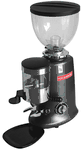
Our largest (and most expensive) commercial coffee grinder is the FAEMA MD 3000. It has a 3.5 pound hopper capacity, and is made to grind up to 25 pounds of coffee beans in an hour. The FAEMA MD 3000 has a die-cast aluminum body that is painted gray to match the FAEMA commercial espresso machines. For a slight price increase, the FAEMA MD 3000 is available in a glossy silver finish.
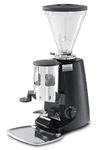
Our two other commercial coffee grinders are the FAEMA MPN, and the La Pavoni ZIP commercial coffee grinders. They are about the same size and capacity, and in a similar price range, with the FAEMA being slightly more expensive. These two machines have a hopper capacity of 2.2 pounds, and can grind up to 16 pounds of coffee beans in an hour.
Both of these commercial coffee machines (the FAEMA MPN and the La Pavoni ZIP) can be ordered with an "Automatic" feature, or not, which is why the two grinders show up as four different products above. And the La Pavoni Zip commercial coffee grinders can be ordered in Shiny Black or in Ruby Red, to match the La Pavoni Star commercial espresso machine finishes.
What the "Automatic" feature of a commercial coffee grinder does is to sense the amount of ground coffee in the chamber of the commercial coffee grinder. When the amount of coffee in the chamber drops below the half-empty point, the commercial coffee grinder turns itself on and fills the chamber, and then it shuts itself off. There is no human intervention required to keep ample ground coffee in the chamber.
For a very busy coffee shop, this is very convenient. You will never have to worry about whether there is ground coffee ready for dosing. The commercial coffee grinder takes care of this for you so you don't need to think about it, and never have to stop to turn the grinder on, or be thrown off-stride because you forgot to grind coffee.
However, many espresso purists feel that ground coffee should not be left sitting for more than ½ hour prior to brewing, and claim to be able to tell whether this was done. Whether or not ½ hour is the breakpoint is not the point. Suffice it to say that ground coffee loses freshness the longer that it sits.
So if you anticipate long slow periods during the day, and/or if you are not running a very high-volume coffee shop, the "Automatic" feature might be something that you actually would prefer to not have. Many shops stop grinding coffee ½ hour before closing. The "Automatic" feature will leave you with a full chamber when you close, unless you remember to turn your commercial coffee grinder off at the ½ hour point.
What we are trying to say is that the "Automatic" feature sounds very nice on a commercial coffee grinder. But make sure that it is right for your coffee shop. In some cases, you might actually regret having this feature. You may find that it is better for you to be the one who decides when it is appropriate for your commercial coffee grinder to grind more coffee.